
South African businesses are under pressure to use AI, but pressure is not a business case.
Buying a tool, opening a few accounts, or asking staff to experiment does not make a company ready. Readiness means the business can identify a valuable workflow, provide trustworthy operating context, assign accountable owners, control sensitive actions, measure the result, and keep improving the system after launch.
A useful AI readiness assessment South Africa business leaders can trust should answer one hard question: where can AI create measurable capacity without creating unmanaged risk?
That answer is more valuable than a generic maturity score. It tells the company what to do first, what must remain human, what needs cleaning up, and whether implementation is commercially sensible now.
Why AI readiness is not mainly a technology question
Many businesses assume readiness depends on software, APIs, or access to the latest model. Those things matter, but they are rarely the first constraint.
AI implementation usually struggles because:
- the workflow is not clearly understood
- nobody can agree where the process starts and ends
- inputs arrive through several informal channels
- important knowledge lives in people’s heads
- documents conflict or have no owner
- exceptions are handled differently by each employee
- the business has not defined what the AI may decide
- sensitive messages or transactions have no approval step
- no person owns the outcome after launch
- success is described as “saving time” without a baseline
- teams are expected to adopt another tool without practical support
The technology can be excellent and the implementation can still fail.
A readiness assessment therefore starts with the business. It examines people, workflow, information, systems, governance, value, and operating ownership before recommending an AI employee or automation.
The seven dimensions of AI readiness
A practical assessment should examine seven connected dimensions. A weakness in one does not always stop the project, but it changes the launch plan.
1. Business-value readiness
The first test is whether the target problem is expensive enough to solve.
Look for a workflow with visible operational pain:
- repetitive staff hours every week
- slow response to leads or customers
- missed follow-ups
- document chasing
- duplicate capture
- reporting assembled manually
- frequent rework or avoidable errors
- senior people checking routine work
- work delayed because knowledge is hard to find
- customers asking repeatedly for status updates
Quantify the annual bleed where possible. Include staff time, owner attention, missed revenue, correction work, delay, customer impact, and risk. If the problem costs the business very little, a sophisticated AI build is unlikely to be the right priority.
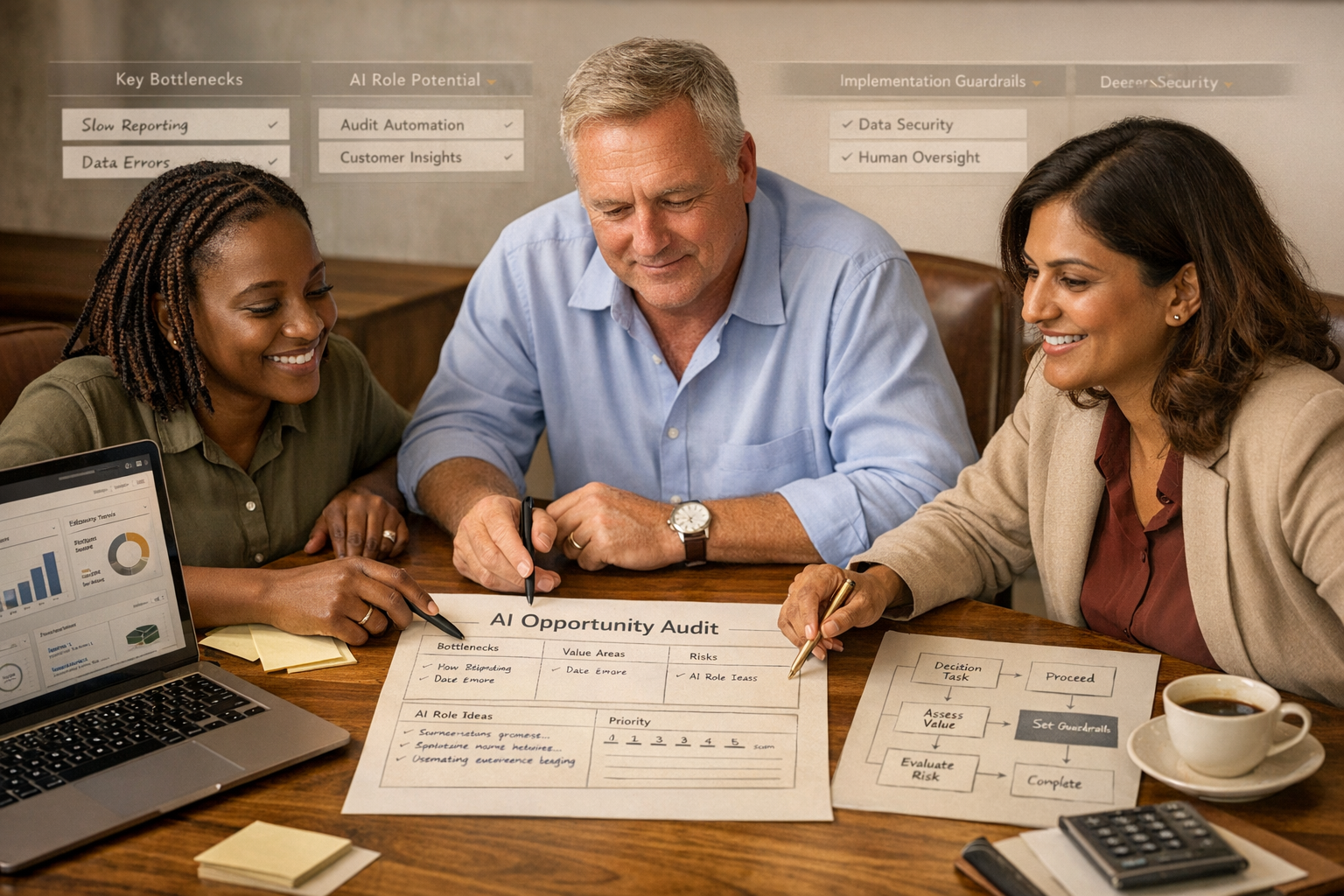
A paid AI Opportunity Audit should anchor implementation against recoverable value rather than novelty.
2. Workflow readiness
The business must be able to describe the real process, not only the official process.
For the candidate workflow, identify:
- the trigger that starts the work
- inputs and their sources
- people and departments involved
- tools used at each step
- decisions made
- common exceptions
- approvals required
- handoffs and waiting periods
- outputs produced
- the event that marks completion
If five employees perform the same task in five different ways, the company may need to agree a minimum operating standard before automation. AI can support a variable process, but it should not quietly turn inconsistency into invisible machine behaviour.
Readiness improves when the first use case is narrow. “Automate operations” is not a workflow. “Collect supplier onboarding documents, check completeness, and prepare an exception queue for human approval” is.
3. Information and Company Brain readiness
An AI employee needs approved context. That may include:
- policies
- standard operating procedures
- product or service information
- templates
- customer communication rules
- role and authority definitions
- escalation routes
- examples of good work
- common exceptions
- previous approved decisions
- data definitions
- legal or compliance guidance reviewed by the right professional
The information does not have to be perfect. It does need owners, source links, sensible version control, and a way to distinguish approved facts from drafts or outdated material.
A Company Brain turns this operating knowledge into a readable, owned structure that people and AI employees can use. The model may change; the company’s captured knowledge, workflow rules, and decision memory should remain its asset.
4. Systems and access readiness
Next, inspect where the work actually happens:
- CRM
- accounting or payroll software
- helpdesk
- shared drives
- spreadsheets
- forms
- calendar
- project-management tools
- industry-specific platforms
For each system, ask:
- Is there a supported integration or reliable export?
- Who owns administrator access?
- Can the AI receive least-privilege permissions?
- Is there a test environment or safe draft mode?
- Can actions be logged?
- Can access be revoked quickly?
- Are data location, retention, and processor terms understood?
- What happens when the integration fails?
A project is not ready merely because an API exists. The full action chain must work safely, including authentication, error handling, approval, read-back, and recovery.
5. Governance and POPIA readiness
AI does not remove the business’s accountability for personal information, customer promises, employment decisions, financial controls, or professional obligations.
The assessment should identify:
- the lawful and specific purpose for processing information
- the minimum information required
- special or sensitive personal information
- who may access inputs and outputs
- where information is stored and processed
- retention and deletion rules
- third-party operators or processors
- security and incident procedures
- human approval points
- prohibited actions
- audit and evidence requirements
No AI product is automatically POPIA compliant. Responsible deployment depends on the complete workflow, contracts, controls, permissions, and human oversight.
Sensitive decisions should remain with authorised people. Examples include legal advice, clinical judgement, hiring or disciplinary decisions, credit decisions, payroll approval, bank-detail changes, payment release, contractual commitments, and emotionally significant customer matters.
6. People and ownership readiness
Every implementation needs named human owners.
At minimum, define:
- executive sponsor
- process owner
- subject-matter reviewer
- system or data owner
- approval owner
- escalation contact
- person responsible for adoption
- person responsible for measuring results
Staff should understand that the purpose is to remove repetitive work and improve control, not to surprise them with a hidden replacement programme.
The people who perform the workflow know where exceptions, workarounds, and customer sensitivities live. Involving them early improves the blueprint and reduces resistance.
A managed AI employee should have a clear job description, reporting line, owner manual, boundaries, and first-day introduction just like a new team member.
7. Measurement and management readiness
Readiness includes the ability to prove whether the system works.
Choose baseline and outcome measures such as:
- first-response time
- turnaround time
- hours spent per case
- outstanding-item count
- follow-up completion rate
- data completeness
- correction or rework rate
- escalation rate
- customer waiting time
- approval cycle time
- qualified opportunities progressed
- report preparation time
Also measure quality. A faster process that sends inaccurate information or creates more review work is not an improvement.
Management continues after launch. Logs, exceptions, corrections, user feedback, and workflow changes should feed monthly optimisation.
A simple AI readiness scoring method
A score can help discussion, but it should not replace judgement. Rate each dimension from 0 to 3:
- 0 — unknown: the business cannot answer the basic questions
- 1 — weak: major gaps could make implementation unsafe or wasteful
- 2 — workable: enough exists for a controlled pilot, with known cleanup tasks
- 3 — strong: owners, sources, controls, measures, and access are clear
Score the seven dimensions:
- business value
- workflow clarity
- information and Company Brain
- systems and access
- governance and risk
- people and ownership
- measurement and management
Do not simply total the numbers. A zero in governance or ownership can be more serious than a low overall score. A high-value workflow with imperfect documentation may still be suitable if the business starts in draft mode and fixes the gaps deliberately.
The decision should be one of four outcomes:
- proceed to a controlled pilot
- proceed after specific readiness work
- choose a narrower use case
- do not build yet
Saying “not yet” can save the company from an expensive experiment.
How to choose the first AI employee
The best first use case is usually a visible golden win: meaningful value, manageable risk, available information, and results that can be measured within weeks.
Strong early candidates often involve:
- lead intake and response drafting
- CRM update preparation
- routine document collection
- inbox triage
- meeting-note processing
- customer status-update preparation
- recurring management reporting
- approved FAQ support
- invoice or quote follow-up coordination
- internal knowledge retrieval
Avoid starting with the most politically sensitive or legally consequential decision simply because it looks impressive.
A good first AI employee:
- performs one defined job
- works from approved sources
- proposes rather than decides during launch
- has clear stop and escalation rules
- leaves evidence for review
- saves measurable time or prevents a visible leak
- helps the team rather than adding another administrative burden
A responsible 30-day readiness-to-pilot path
A business with a suitable workflow can move quickly without being careless.
Week 1: diagnose the workflow
Map the current process, quantify the annual bleed, interview the people doing the work, collect baseline measures, and identify the most expensive friction.
Week 2: blueprint the AI employee
Define the job description, inputs, outputs, tools, approved knowledge, forbidden actions, approval points, escalation rules, owner, and success metrics.
Week 3: prepare the operating environment
Clean the minimum required information, organise the Company Brain, configure least-privilege access, prepare test cases, and establish logs and review queues.
Week 4: run a controlled working interview
Operate in observation or draft mode. Compare AI outputs with real human work, record failures, correct knowledge and rules, and expand permissions only when evidence supports it.
This is safer than a dramatic big-bang launch and faster than spending months writing a theoretical AI strategy.
Warning signs that the business is not ready
Pause or narrow the project if:
- there is no process owner
- nobody will review outputs
- the goal is only “we need AI”
- the workflow volume is too low to justify the effort
- source information is inaccessible or untrustworthy
- leaders expect the AI to infer undocumented policy
- critical actions cannot be separated from routine administration
- required system access is unavailable
- there is no lawful or clear purpose for using the data
- the company wants uncontrolled external sending from day one
- success cannot be measured
- the implementation has no ongoing owner or management budget
These are not reasons to abandon AI forever. They are signals to fix the operating foundation or select a better first workflow.
Frequently asked questions
What is an AI readiness assessment?
It is a structured review of business value, workflow clarity, information, systems, access, governance, people, ownership, and measurement. The output should be a practical implementation decision and a prioritised first use case.
Does our data need to be perfect?
No. It needs to be fit for the defined use case. The business should know which sources are authoritative, who owns them, what quality issues exist, and how uncertain information will be handled.
Can a small or medium South African business be AI ready?
Yes. Readiness is not determined by company size. An established SME with a clear repetitive workflow and an accountable owner may be more ready than a large business with fragmented processes and unclear authority.
What happens after the assessment?
The next step may be a controlled pilot, targeted readiness work, a narrower workflow, or no build. A serious assessment should provide the evidence, priorities, controls, measures, and phased roadmap needed to make that decision.
Turn readiness into a commercial implementation decision
Do not buy AI because the market is noisy. Find the workflow where your business is losing time, missing follow-ups, repeating work, or relying on knowledge trapped in people’s heads. Then test whether the value, information, systems, governance, and ownership are strong enough to act.
BizSage’s AI Opportunity Audit is a paid diagnostic for established South African businesses. It maps the real workflow, quantifies the annual bleed, identifies readiness gaps, defines what must remain human, and recommends the first Company Brain and AI employee opportunity worth implementing.
If the evidence says build, you will know what to build and why. If it says fix the foundation first, you avoid paying for the wrong system.
FAQs
What is an AI readiness assessment?
An AI readiness assessment checks whether a business has a valuable workflow, usable information, responsible ownership, suitable systems, clear approval rules, and measurable outcomes before implementation begins. It should produce priorities and a practical first use case, not a generic maturity score.
Does a business need perfect data before using AI?
No. The business needs enough reliable, accessible, and appropriately governed information for one defined workflow. An assessment should identify which gaps must be fixed before launch and which can be improved during a controlled pilot.
How long does an AI readiness assessment take?
A light internal screen can take a few hours, but a serious paid assessment may take several working sessions because it must inspect the workflow, systems, data, risks, human decisions, volumes, costs, and implementation constraints.
What should happen after the assessment?
The business should receive a prioritised opportunity map, a quantified first use case, clear human-control requirements, a data and access plan, success measures, and a phased implementation recommendation. If the evidence is weak, the correct next step may be process cleanup rather than an AI build.