
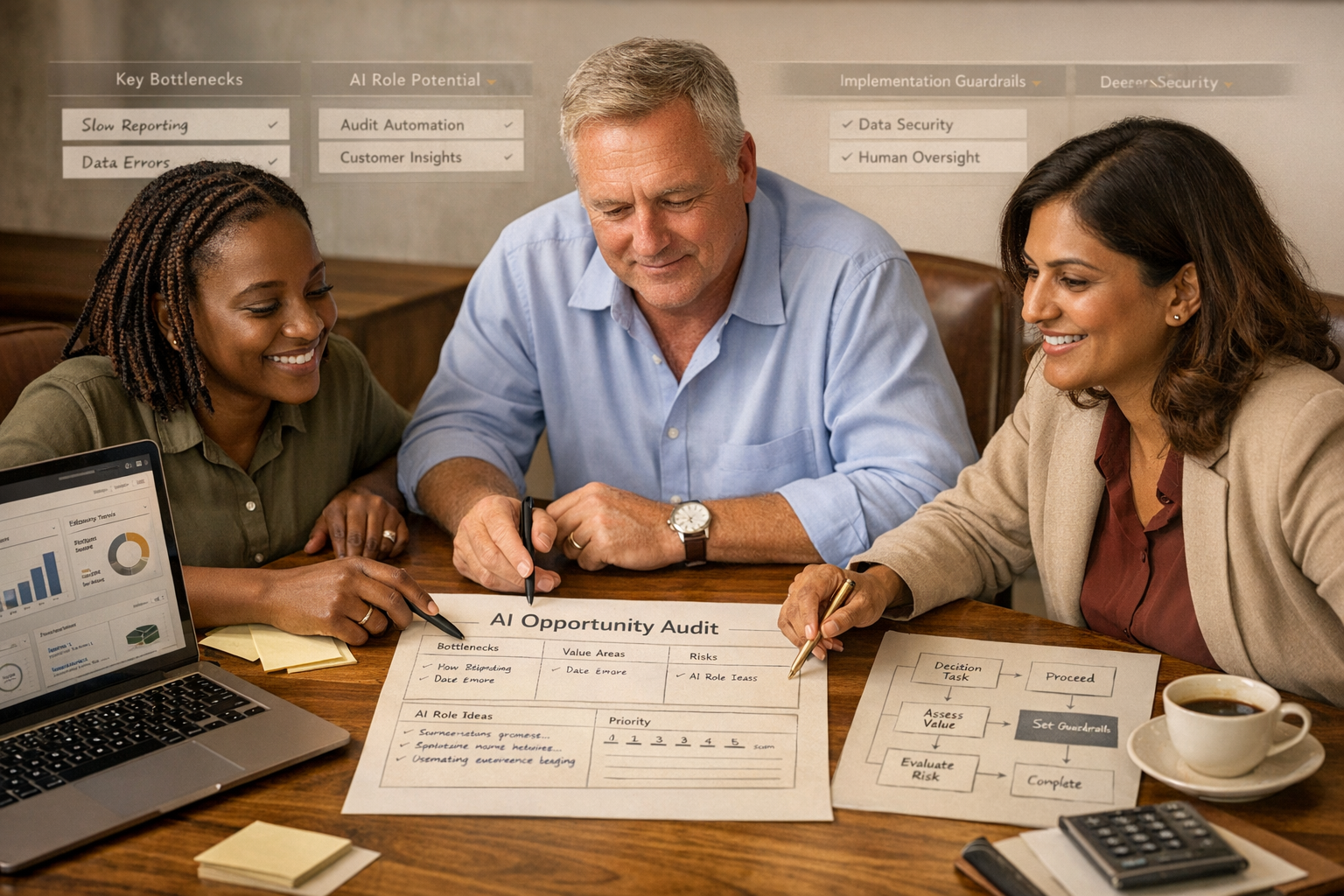
An AI pilot should not be a company-wide experiment with a vague promise to “see what happens”. It should be a controlled working interview for one useful role.
For established South African businesses, the strongest first pilot normally targets a workflow the team already performs every week: responding to enquiries, collecting documents, updating a CRM, preparing client updates, triaging an inbox, or assembling a management report.
A credible AI employee pilot South Africa business leaders can trust has a named owner, approved information, narrow permissions, human approval points, baseline measures, and a clear decision at the end. The purpose is not to prove that AI can produce impressive text. It is to prove that the business can create reliable capacity without losing control.
Start with a business result, not an AI feature
The first question is not “Which model should we use?” It is “Which recurring business problem is expensive enough to fix?”
Look for operational symptoms such as:
- new enquiries waiting too long for a response
- staff repeatedly chasing the same documents
- sales opportunities disappearing because follow-up is inconsistent
- client updates assembled manually from several systems
- inboxes holding work that nobody has classified or assigned
- CRM records becoming incomplete after calls and meetings
- managers spending hours compiling routine reports
- owners checking whether ordinary tasks happened
- experienced employees answering the same internal questions
- avoidable rework caused by missing context or poor handoffs
A pilot should have commercial weight. Estimate the annual bleed before building anything:
- cases or transactions per month
- minutes of staff time per case
- loaded employment cost of the people involved
- management review and owner-chasing time
- rework or correction rate
- delayed or missed revenue opportunities
- customer waiting time and complaint impact
- operational or compliance exposure
Use the company’s own evidence. Do not inflate the number to justify a fashionable project. If the workflow is not materially painful, choose another one.
A structured AI Opportunity Audit identifies the best first workflow and tests whether the likely return justifies implementation.
Choose one narrow workflow for the pilot
“AI for sales” is too broad. “Operations automation” is not a testable scope.
A strong pilot boundary sounds like this:
The pilot begins when an approved website enquiry arrives and ends when the lead has a complete CRM record, a human-approved response, a responsible owner, and a dated next action.
Or:
The pilot begins when client documents arrive in the approved inbox and ends when the file is classified, checked against the document list, and either marked complete or placed in a human exception queue.
Good first workflows usually have five characteristics:
- Frequency: enough cases occur during the pilot to produce evidence.
- Repetition: the core steps are broadly consistent.
- Value: faster or better execution creates visible capacity or revenue protection.
- Reviewability: a responsible person can judge whether the output is correct.
- Containment: errors can be caught before they cause serious harm.
Do not start with final legal advice, medical judgement, hiring decisions, payment release, credit decisions, contractual commitments, or angry-customer resolutions. AI may help prepare information in these areas, but accountable professionals must retain the decision.
Define the AI employee like a real role
A pilot becomes clearer when the system has a job description rather than a collection of prompts.
Define:
- role title
- purpose
- workflow boundary
- tasks it performs
- systems it may read
- systems it may update
- approved knowledge sources
- actions it may take
- actions it may only draft
- actions it may never take
- human manager
- approval owner
- escalation contacts
- expected service levels
- quality measures
- common failure cases
For example, an AI Revenue Assistant may acknowledge a new enquiry, collect approved qualification details, draft a reply, update CRM fields, and remind the salesperson about a missed next action. It may not negotiate price, make promises outside approved terms, approve discounts, or represent uncertain information as fact.
This role design is what separates a managed AI employee from casual use of a general chatbot.
Build the minimum Company Brain
The AI employee needs approved operating context. Without it, the pilot is testing whether a model can guess — not whether the business can deploy a reliable role.
For one workflow, the minimum knowledge pack may include:
- relevant services and customer types
- standard operating procedure
- approved templates
- qualification or completeness criteria
- pricing or policy boundaries
- terminology and data definitions
- brand and communication tone
- examples of good outputs
- common exceptions
- approval rules
- escalation routes
- source-system ownership
- retention and deletion rules
Every important fact should have an owner and source. Drafts, expired documents, and personal notes should not silently become policy.
A Company Brain gives this information a readable, owned structure. The business should retain its workflow knowledge, rules, examples, and decision memory even if the underlying AI model or implementation partner changes later.
Set POPIA, security, and authority boundaries before testing
A pilot is small, but it is still real processing.
Before data enters the workflow, document:
- the specific business purpose
- categories of personal information involved
- whether special personal information appears
- which systems receive or store the information
- which service providers process it
- access permissions
- retention period
- deletion process
- incident and escalation route
- logging requirements
- human approval points
- prohibited uses
Use least-privilege access. If the employee only needs to read new enquiries and draft a response, do not give it broad administrator rights across the CRM.
Keep high-impact actions human-controlled. Examples include:
- changing bank details
- releasing payments
- signing or accepting terms
- giving professional advice
- making employment decisions
- disclosing confidential records
- changing customer entitlements
- sending emotionally sensitive communication
- approving refunds or discounts outside policy
No tool is automatically POPIA compliant. Compliance depends on the complete workflow, purpose, access, contracts, retention, safeguards, and responsible human oversight.
Record the baseline before the pilot starts
Without a baseline, a positive result becomes an opinion.
Measure the current workflow for a representative period. Depending on the role, capture:
- first-response time
- turnaround time
- staff minutes per case
- backlog volume
- percentage completed on time
- follow-up completion rate
- data completeness
- number of manual handoffs
- correction and rework rate
- customer chasing or complaints
- manager review time
- opportunities progressed
- reports completed by deadline
Also record quality and risk. A workflow that becomes faster but produces more corrections has not improved.
Agree the pilot’s success threshold before launch. An example could be:
- all new enquiries acknowledged within ten minutes during operating hours
- at least 95% of required CRM fields captured correctly
- no unapproved commercial commitments
- salesperson review time below three minutes per case
- complete activity and source logs
- every uncertainty escalated rather than guessed
The exact measures should fit the workflow. The principle is simple: speed, quality, control, and human effort must all be visible.
Use a four-stage 30-day working interview
A controlled pilot should earn authority instead of receiving it on day one.
Stage 1: shadow mode
The AI employee observes inputs and produces an internal recommendation without changing systems or communicating externally.
The team checks:
- whether the correct cases are detected
- whether the right sources are used
- whether classifications make sense
- whether exceptions are recognised
- whether the proposed next action matches policy
Shadow mode exposes missing knowledge and misunderstood rules cheaply.
Stage 2: draft mode
The AI prepares the real output, but a human reviews and sends or applies it.
Examples include:
- response drafts
- CRM update suggestions
- document-completeness checks
- client-status drafts
- meeting follow-up notes
- management summaries
Reviewers should record corrections and reasons. “Changed it” is weak feedback. “The draft used an outdated cancellation rule” creates a useful knowledge update.
Stage 3: controlled action
After consistent performance, the employee may take narrowly approved actions automatically.
Examples might include:
- acknowledging receipt
- creating an internal task
- tagging a message
- updating a low-risk status field
- sending an approved reminder
- placing an incomplete case in an exception queue
Every action should be logged and reversible where practical. Sensitive cases remain in approval mode.
Stage 4: go-live review
At the end of the working interview, compare results with the baseline and decide:
- go live within the tested boundary
- continue the pilot to collect more evidence
- narrow the role
- repair information or process gaps
- change the implementation
- stop because the value or reliability is insufficient
Stopping a weak pilot is not failure. It is cheaper than scaling a bad system.
Create an exception queue, not a pretending machine
A trustworthy AI employee knows when not to proceed.
Typical escalation triggers include:
- missing information
- conflicting records
- uncertain identity
- an unfamiliar request
- a policy exception
- low confidence
- complaint or distress
- legal or compliance question
- unusual amount or commercial term
- suspected fraud
- system outage
- deadline risk
- request from an unauthorised person
Each exception needs a named destination, required evidence, priority, and expected response time.
Do not judge the pilot only by how many cases the AI completes. Measure whether it identifies uncertainty honestly and sends exceptions to the right human. Safe escalation is productive work.
Review the pilot every day and every week
During a first implementation, feedback should be fast.
A short daily review can cover:
- cases processed
- approvals requested
- corrections made
- exceptions raised
- failed integrations
- delayed cases
- any customer or staff concern
A weekly review should examine patterns:
- repeated corrections pointing to missing knowledge
- rules that need clarification
- reviewers who apply different standards
- unnecessary approval steps
- access or integration problems
- quality and time trends
- new risks revealed by real use
Update the approved knowledge and workflow deliberately. Do not let ad hoc corrections disappear in chat threads. The point of the pilot is to strengthen the company’s operating memory as well as the employee’s output.
Involve the people who do the work
A pilot imposed on a team usually produces poor information and defensive behaviour.
Explain the purpose plainly: remove repetitive work, improve follow-through, reduce chaos, and make important exceptions visible. Do not use shock language about replacing staff.
The people performing the workflow know:
- which inputs normally arrive incomplete
- which customers need special care
- where the official process differs from reality
- which workarounds keep the business functioning
- what a good output looks like
- which mistakes are expensive
- when judgement is needed
Give reviewers a simple owner manual. It should explain what the employee does, how to request work, what must be approved, what it will refuse, and how to report a problem. Adoption improves when the system feels like visible support rather than a mysterious background automation.
Avoid the most common pilot mistakes
Testing too many workflows
A broad pilot produces weak evidence. One workflow with sufficient volume is more useful than five shallow demonstrations.
Using artificial examples only
Synthetic tests are useful before launch, but the working interview must include representative real cases under controlled conditions.
Measuring activity instead of outcomes
Emails drafted and records processed are not the final value. Measure reduced waiting, staff time, data quality, follow-up completion, and business movement.
Giving broad access too early
Convenience is not a reason for excessive permissions. Start narrow and expand only when justified.
Ignoring exception behaviour
The easy cases do not prove safety. Deliberately test missing, conflicting, unusual, and sensitive inputs.
Treating the pilot as a once-off build
Workflows, policies, teams, and customer expectations change. A useful employee needs monitoring, knowledge updates, failure review, and optimisation after go-live.
Scaling before the process owner trusts it
Executive excitement is not operational readiness. The accountable manager and frontline reviewers must trust the tested boundary.
Decide what happens after the pilot
A successful pilot should produce more than permission to buy software.
The final pack should include:
- tested workflow map
- role blueprint
- approved and prohibited actions
- knowledge-source register
- baseline and outcome results
- corrections and exception analysis
- security and access record
- human approval design
- unresolved risks
- go-live scope
- monitoring plan
- ownership and escalation responsibilities
- next improvement backlog
If the pilot proceeds, establish a managed operating rhythm. Monthly review should inspect performance, failures, changed knowledge, staff feedback, customer impact, and possible expansion.
Expansion should be earned. The next role or workflow should be chosen because evidence supports it — not because the first demonstration looked impressive.
A practical pilot checklist
Before launch, confirm:
- one workflow has a clear start and finish
- annual bleed and expected value are credible
- a human process owner is accountable
- the AI employee has a written job description
- approved knowledge sources are identified
- POPIA and security requirements are documented
- permissions follow least-privilege principles
- sensitive actions require human approval
- exceptions have named escalation routes
- current performance has been measured
- success thresholds are agreed
- logs and source evidence are retained appropriately
- reviewers know how to record corrections
- rollback or stop conditions are clear
- the go-live decision has a named owner
Turn one painful workflow into controlled proof
A serious AI pilot does not ask the company to trust AI in general. It asks the company to test one defined employee, doing one useful job, under visible human control.
BizSage helps established South African businesses identify the workflow with the strongest combination of value, feasibility, and manageable risk. The paid AI Opportunity Audit maps the current process, quantifies the annual bleed, reviews systems and information, defines human controls, and scopes the first managed AI employee worth testing.
Find your best first AI workflow before spending money on a broad experiment.
Frequently asked questions
What is an AI employee pilot?
An AI employee pilot is a controlled test of one defined business role or workflow. It uses approved information, explicit boundaries, human oversight, and agreed measures to determine whether the system creates reliable operational value.
How long should an AI employee pilot run?
Thirty days is often enough for a frequent, narrow workflow to move through shadow, draft, controlled-action, and review stages. A lower-volume or seasonal process may need a longer evidence period.
Which workflow is best for a first AI pilot?
Choose frequent, repetitive work with visible cost, accessible information, a named owner, and outputs that humans can review. Lead response, document collection, inbox triage, CRM updates, status preparation, and recurring reporting are common starting points.
Does an AI pilot need human approval?
Yes, wherever outputs could affect money, rights, professional advice, customer trust, legal obligations, employment, health, safety, or reputation. Narrow low-risk actions can earn greater autonomy only after measured, reliable performance.
FAQs
What is an AI employee pilot?
An AI employee pilot is a controlled test of one defined business role or workflow. The system works from approved information, follows explicit boundaries, keeps humans responsible for sensitive decisions, and is measured against a real operational baseline before wider use.
How long should an AI employee pilot run?
Thirty days is often enough for a narrow, frequent workflow to move through shadow, draft, controlled-action, and review stages. Lower-volume or highly seasonal workflows may need a longer evidence window.
Which workflow is best for a first AI pilot?
Choose frequent, repetitive work with visible cost, accessible information, a named process owner, and outputs that humans can review. Lead response, document collection, inbox triage, CRM updates, client-status preparation, and recurring reporting are common candidates.
Does an AI pilot need human approval?
Yes, wherever an output could affect money, rights, professional advice, customer trust, legal obligations, employment, health, safety, or reputation. Approval rules can be relaxed only after evidence shows that a narrow action is reliable and low risk.