
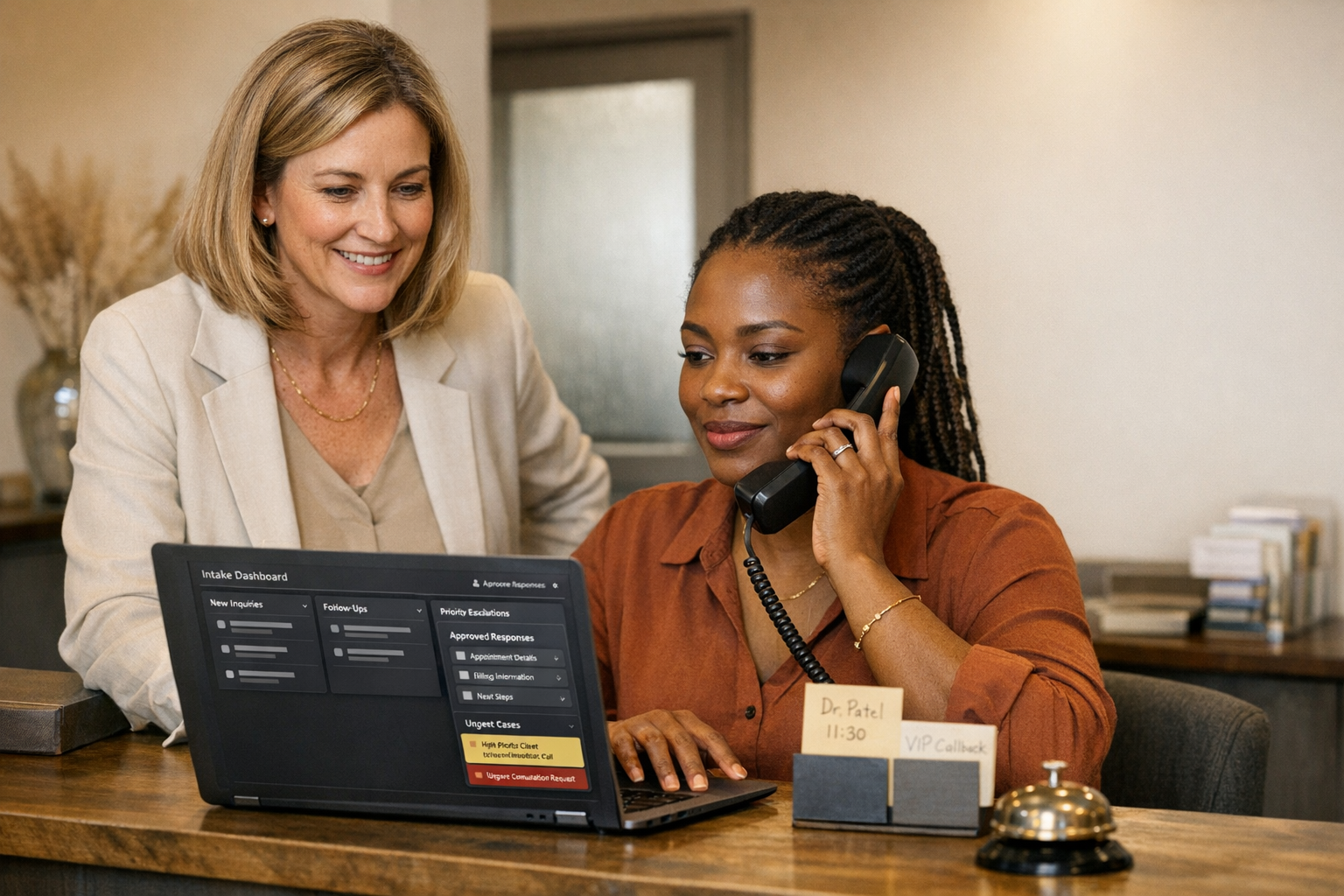
Automotive dealerships and workshops live on timing. A missed call, slow service booking reply, forgotten quote follow-up, or unclear customer update can cost real money.
The problem is rarely that the team does not care. The problem is that front desks, service advisers, salespeople, technicians, and owners are all busy at the same time. Enquiries arrive through calls, website forms, email, WhatsApp, social messages, and walk-ins. Some need a simple booking. Others need pricing, parts checks, warranty context, or a human decision.
An AI service booking assistant for automotive businesses in South Africa can help by taking repetitive coordination work off the team while keeping staff in control of commitments.
This is not about replacing the service adviser. It is about making sure routine customer communication does not fall through the cracks.
Where automotive businesses lose time and revenue
Dealerships and workshops often have several small leaks that add up:
- service enquiries are not answered quickly enough
- customer details arrive incomplete
- quote follow-ups depend on memory
- booking requests sit in an inbox
- reminders are inconsistent
- customers phone for status updates because nobody has updated them
- parts delays are not communicated clearly
- sales and service leads are mixed together
- managers do not get a clean daily view of missed opportunities
For South African automotive businesses, this matters because many customers compare responsiveness. If one workshop responds clearly and another leaves the customer waiting, the faster business can win trust before price is even discussed.
A managed AI employee can help create discipline around those repeated communication steps.
What an AI service booking assistant should do
A useful assistant needs a narrow, practical job description. It should not pretend to diagnose vehicles or make uncontrolled promises.
The first version can help with:
- acknowledging new service enquiries
- collecting name, contact details, vehicle make, model, year, mileage, and issue
- asking whether the customer needs service, repair, inspection, tyre work, parts, or a quote
- preparing a booking request for staff review
- drafting appointment reminders
- following up on unconfirmed bookings
- sending approved status update drafts
- summarising daily service enquiries for a manager
- routing urgent or unclear cases to a human
This overlaps with the BizSage AI Receptionist and AI Customer Support Assistant models: handle routine intake, collect context, route the right work, and escalate exceptions.
Keep humans in control of pricing and promises
Automotive workflows can become risky when AI makes commitments it should not make.
A responsible AI service booking assistant should not:
- confirm workshop availability without access to approved booking rules
- promise repair times without human confirmation
- quote prices unless the price source is approved
- diagnose mechanical issues as fact
- handle complaints without escalation
- change warranty or payment terms
- send sensitive messages without review
The safe starting point is often approval mode. The AI drafts the response, collects the details, prepares the booking note, and asks staff to approve or adjust before anything final goes to the customer.
Once the workflow is stable, some low-risk messages can be automated. But the business should earn that automation through testing, not assume it on day one.
Strong first workflows for dealerships and workshops
The best first AI employee is usually the one that reduces obvious daily friction.
Service booking intake
The assistant can answer new service enquiries with a clear intake flow. It collects the right information, prepares a booking request, and sends the team a clean summary instead of forcing staff to piece together scattered messages.
Quote follow-up
Many quote requests go quiet because follow-up is inconsistent. An AI assistant can remind the customer, ask if they have questions, and alert a human when the customer responds with buying intent or a concern.
This links directly to AI sales follow-up because the principle is the same: good opportunities should not disappear because the team got busy.
Appointment reminders
Routine reminders reduce no-shows and confusion. The assistant can prepare reminders for service appointments, inspection bookings, test drives, or collection times, depending on the business rules.
Customer update drafts
Customers become anxious when they do not know what is happening. The assistant can prepare update drafts such as “vehicle received”, “awaiting parts”, “technician inspection in progress”, or “ready for collection” for staff approval.
Daily manager summary
At the end of the day, the assistant can summarise:
- new enquiries
- bookings requested
- bookings confirmed
- quotes awaiting follow-up
- customers needing a human response
- unresolved complaints or delays
- missed information
Owners and managers do not need another dashboard. They need a plain-English summary of what needs attention.
How this improves customer experience
Most customers do not need fancy AI. They need a business that responds, remembers, and keeps them informed.
A good AI service booking assistant can improve:
- response speed
- consistency of information collected
- quality of handovers to staff
- reminder discipline
- follow-up on quotes and bookings
- visibility for managers
- customer confidence during service delays
This is the human value. The customer feels less ignored. The service adviser spends less time repeating basic questions. The owner has better visibility. The business looks more organised.
That is the standard BizSage cares about: practical AI employees that help people do better work.
What needs to be mapped before implementation
Before installing an AI employee, the business should map the real workflow. Do not start with the tool. Start with the operating pain.
For automotive businesses, the mapping should cover:
- where service enquiries arrive
- who currently responds
- what details are always needed
- which booking system or calendar is used
- which messages need approval
- which prices or answers are approved
- how urgent cases are identified
- how complaints are escalated
- how quote follow-up currently happens
- what daily report the owner or manager needs
This is exactly what the BizSage AI Opportunity Audit is designed to uncover. The audit identifies whether service booking intake, quote follow-up, customer updates, or another workflow is the best first AI employee.
When automotive AI automation is a strong fit
An AI service booking assistant is a strong fit when the business has:
- regular inbound service enquiries
- missed calls or slow replies
- staff repeating the same intake questions
- quote follow-ups that are not consistent
- customers asking for updates across multiple channels
- no clean daily view of service pipeline activity
- enough volume to justify a managed workflow
It is a weak fit when the business has very low enquiry volume, no responsible owner for the workflow, or no willingness to define service rules and escalation boundaries.
AI needs operational ownership. Without that, it becomes another tool that nobody trusts.
The practical next step
For a South African dealership or workshop, the first question is not “which AI platform should we buy?”
The better question is: where are we losing time, bookings, or customer trust because follow-up and communication are inconsistent?
If the answer is service enquiries, booking coordination, quote follow-up, or customer updates, an AI service booking assistant may be a sensible first AI employee.
Start narrow. Keep staff in control. Measure the result. Improve it monthly.
If you want to find the best first workflow, book the BizSage AI Opportunity Audit. We will map the communication leak, define the AI employee role, and show whether the implementation is worth doing.
FAQ
What is an AI service booking assistant?
An AI service booking assistant helps respond to service enquiries, collect vehicle and customer details, prepare booking requests, send reminders, follow up on quotes, and escalate exceptions to dealership or workshop staff.
Can it diagnose vehicle problems?
No. It can collect symptoms and context for staff, but diagnosis and repair decisions should stay with qualified people. That boundary protects customers and the business.
Should the assistant send messages automatically?
Not at first for every message. Many businesses should begin in draft or approval mode, then automate only the low-risk messages once the workflow has been tested.
What is the safest first automotive workflow to automate?
Service booking intake, appointment reminders, quote follow-up, and daily enquiry summaries are usually safer starting points than pricing decisions, technical diagnosis, warranty decisions, or complaint handling.
FAQs
What is an AI service booking assistant?
An AI service booking assistant helps respond to service enquiries, collect vehicle and customer details, suggest next steps, prepare booking requests, send reminders, and escalate exceptions to dealership or workshop staff.
Can an AI assistant handle automotive bookings without staff approval?
It depends on the workflow. Many businesses should start with draft or approval mode so staff confirm availability, pricing, and exceptions before the customer receives a final commitment.
Which automotive workflows should be automated first?
Good first workflows include service booking intake, quote follow-up, appointment reminders, missing information chasing, customer update drafts, and daily enquiry summaries.